your root system knows you
This week, your root system learns who you are. Your values, your work, your voice. Then it builds something real.
👇 After this module
Your root file is written, your root system knows your life and your work, and you have built your first page.
What you'll do this week
- Your Root Scan, open the project in Claude, run the onboarding scan, answer the questions about your life and work
- The Onboarding Conversation, let Claude write your goals, current state, and rhythms into your fact files
- Knowledge Import, drop in your existing materials (notes, docs, transcripts) so the system has context to work from
- Your About Page, generate your first public page from your root file, deploy it, see your story live
What you'll leave with
- Claude Code installed and running on your machine
- Your root file (CLAUDE.md) written, with your goals and current state
- Fact files populated: identity, goals, current state, rhythms
- Your first knowledge imported and indexed
- A live About page on the web, generated from your root system
Why this matters
Before your system can help you, it has to know who you are. Not your business plan. You. After this week, your system is already different from everyone else's because it grew from your answers, your life, your words. That is by design. The foundation everything else grows from is you.
Start here
Lesson 1: Your Root Scan →
Your Root System Scan
Before your system can help you, it needs to know who you are. Not your business plan. Not your target audience. You. What you believe, how you work, who you serve, what you already have.
The Root System Scan is a guided conversation that takes about 15 minutes. It walks you through all four languages and produces two things:
📄 Your root file (CLAUDE.md)
The first version of your root file. Same file, two names: Claude looks for it as CLAUDE.md, we call it the root file. Who you are, who you serve, how you work, what you have, and the rules your system should follow. Written as instructions, not descriptions.
📝 Your about page draft
The foundation for your public-facing story. What you believe, what you do, who you work with, how you got here. In your voice, using your words.
Why this matters
Your root file becomes the first thing your AI system reads every single session. When Claude writes your content, builds your pages, or helps you make decisions, it starts here. The deeper you go in this scan, the better everything after it works.
How it works
The scan is a conversation. It asks you about what's not working, then walks through each language (mind, heart, body, soul), surfaces your pattern, and assembles the raw material into your root file and about page. You can type or use voice.
At the end, you download your root file as a markdown file. You will use this in the next lesson when you set up your system.
Start your Root System ScanPrefer to do this in Claude Code?
If you already have Claude Code set up, you can run the same scan as a conversation in your terminal. Open Claude Code in your project folder, paste the prompt from the Root System Scan README, and work through it there. Same questions, same output, different interface.
The onboarding conversation
You already have your root file draft from the scan. Now we go deeper.
The scan gave you the shape of who you are across all four languages. The onboarding conversation takes that shape and fills it in with real detail: your actual methodology, your specific offerings, your brand colors, your work rhythms, the tools you use, who you want to reach, and what you are building toward. This is where your root system goes from "knows who you are" to "knows how to work for you."
Before you start
Need the template repo?
To get started, you need access to the root system template. Send your email to maaria@thefourlanguages.com and you will receive an invite to the template repository.
Need to install Claude Code?
If you have not set up Claude Code yet, follow the Step 0: Get Set Up guide first. It walks you through everything you need. You can also check Anthropic's official Claude Code Quickstart for additional guidance.
How it works
You can run the onboarding from either the terminal or the Claude desktop app. Both work the same way.
Option 1: Terminal
First, navigate into your project folder (the folder where your root system lives):
Replace sarah-coaching with whatever you named your folder.
Then start Claude Code:
Option 2: Claude app
Open the Claude desktop app, click the Code tab at the top, and select your project folder from the list (or choose a different folder).
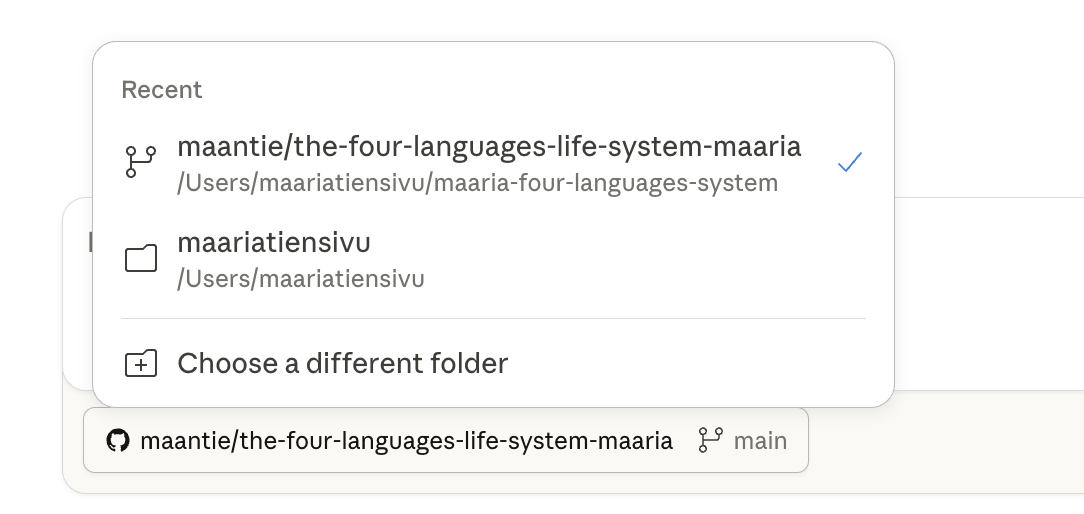
Once you are in, type /onboarding and press enter.
If /onboarding does not work
Some setups do not support slash commands. If that happens, just type: "Run the onboarding skill from .claude/commands/onboarding.md" and Claude will find it and walk you through the same conversation.
If you completed the Root System Scan, paste your downloaded root file when prompted. Claude will use it as a starting point so you do not repeat yourself. If you skipped the scan, that is fine too. Claude will ask everything from scratch.
The onboarding walks through five sections. Each one goes deeper than the scan did:
Soul
Your values, purpose, reflective practice, what your ideal day actually looks like
Mind
Your methodology, specific offerings, ideal client in detail, 12-month vision
Heart
Your voice, how you actually talk, where your people find you, how you build trust
Body
Your work rhythms, tech stack, brand elements (colors, fonts), what you want tracked
Plus: The Big Picture
At the end, Claude asks why you are here and what would make this sprint worth it. This becomes the filter for everything your system suggests and builds.
This is a real conversation, 30 to 45 minutes depending on how deep you go. Claude asks, listens, mirrors back what it heard, and then writes your system files in real time. The deeper you go, the better everything works from here.
What it creates
As you answer each section, Claude writes files into your project. By the end, you will see a receipt showing everything it created:
context/memory/fact/identity.yaml ✓ Values, purpose, philosophy
context/memory/fact/business.yaml ✓ Methodology, offerings, ideal client
context/memory/fact/preferences.yaml ✓ Voice, communication style
context/memory/fact/brand.yaml ✓ Colors, fonts, visual identity
context/memory/fact/goals.yaml ✓ 12-month vision, sprint goal
context/memory/fact/current-state.yaml ✓ Rhythms, tracking, accountability
context/memory/fact/tech-stack.yaml ✓ Tools and platforms
mind/content/voice-guide.md ✓ How you sound in writing
body/dashboard/data/contacts.json ✓ Your existing network
The scan gave you one file (your root file draft). The onboarding creates ten. Together, they mean your root system knows your values, your methodology, your voice, your rhythms, your tools, your goals, and who matters to you. That is the foundation everything else builds on.
What happens after onboarding
Once your onboarding is complete, your root system gets better every day. Here is what that looks like:
Daily check-ins
Every time you open Claude Code and say good morning, your root system checks in with you. How are you feeling? What are you working on? What is your energy like? These check-ins get logged. Over time, they reveal your patterns.
Reflective practice
If you have a reflective practice (journaling, meditation, pulling a card, prayer, nature time), your root system can support it. Tell it what you do. It will prompt you, log your reflections, and track consistency. Your reflections are saved as files on your machine. Remember: anything you type in a conversation with Claude is processed through Anthropic's API, so be mindful of what you share directly versus what you write to files separately.
Voice refinement
The more you interact with your root system, the more it sounds like you. When it writes something that feels off, tell it. "Too formal." "I would never say that." "More like how I would text a friend." It learns. In Module 2, you will understand exactly how.
Make sure it actually saved
The conversation feels good, but the only thing that matters is whether the files actually landed on your machine. Before you mark this lesson complete, do this verification.
1. Ask Claude to show you what got saved
When the conversation ends, just say:
2. Ask Claude what is still missing
Then ask:
If anything is empty or vague, tell Claude what to fix: "I want to add more about my work. Let's go back to that part."
3. Check it sounds like you
Then ask Claude:
If it sounds generic, say: "Rewrite it in my actual voice using my own words from this conversation. Less polish, more me."
If something goes wrong
Claude is rushing through the questions
Tell it: "Slow down. Ask me one question at a time and wait for my answer before moving on. I want to go deep on this."
Claude is asking questions but not saving anything
Stop and say: "Make sure you are actually saving my answers to the right folders as we go. After every section, save what we just talked about and tell me where it went."
The conversation stopped halfway through
Start Claude again in the same folder and say: "I started the onboarding earlier and we got partway. Look at what I already told you, tell me what is still missing, and let's pick up from there."
You want to redo a section
Just say: "Let's redo the [Soul / Mind / Heart / Body] section. I want to go deeper." Claude will re-ask and update what is saved.
Still stuck?
Email maaria@thefourlanguages.com with what you tried and a screenshot of where you got stuck. I will get you unstuck.
Import your existing knowledge
Your root system now knows who you are. But you have years of work that Claude has never seen: your methodology documents, workshop materials, client frameworks, contact lists, brand guides, content archives, strategy docs. All of that knowledge is sitting in Google Docs, Notion, slide decks, CSVs, and folders on your computer. Until Claude can read it, it is invisible.
This lesson is about bringing that knowledge in, in a format your root system can actually use.
Why format matters
Claude reads markdown (.md) and YAML (.yaml) files best. A messy Google Doc export with broken formatting, duplicated headers, and outdated sections makes Claude work harder and produce worse results. When you ask Claude to process your raw files, it strips the noise, organizes the content with clear headings, removes what is outdated, and creates a version optimized for how it reads.
Only accurate data produces accurate results. This is the perfect time to decide what is current and what is not. If you import an old pricing page, Claude will use those numbers. If you import a framework you no longer teach, Claude will reference it. Be selective. Bring in what is true NOW.
Which language does this go under?
Everything in your root system lives under one of the four languages. When you import something, you need to know where it belongs. Ask yourself: what is this material FOR?
Soul
Mission statements, personal values, journal entries, your "why" document, reflective practice notes
Mind
Your methodology, workshop materials, training decks, SOPs, pricing, strategy docs, proposals
Heart
Contact lists, testimonials, email templates, voice guide, community notes, client intake forms
Body
Published content, brand guidelines, website copy, analytics data, design files
If something crosses languages, put it where its PRIMARY purpose lives. Your framework might touch Soul (why) and Mind (how), but if you mainly use it to structure your client work, it is Mind.
How to import
You do not need to reformat everything yourself. Claude does it for you.
This is my signature methodology. Can you read it,
turn it into clean markdown, and save it to mind/?
root system: I read the file. Here is what I found...
I will save it to mind/frameworks/coaching-method.md.
Should I also add a reference in your root file?
What to prioritize
Start with 3 to 5 files. You can always add more.
Files can wait. The frameworks, beliefs, methods, and stories that only exist in your brain are invisible to Claude until you get them out. Type them, speak them, whatever works. "Here is how my coaching process works..." and Claude will organize and save it for you.
The full guide with bulk import instructions (CRM data, content archives, large exports) is in your starter system at guides/04b-knowledge-import.md. Ask Claude: "Help me with guide 04b" and it will walk you through it.
Your about page
Your root system knows you now. Time to see what it can do with that knowledge.
The scan gave you an about page draft. The onboarding deepened everything. Now you turn all of that into a visual page so you can see what your system actually knows about you. Think of it as a mirror: your root system reflecting back who you are, in a format you can look at and refine.
How it works
In Claude Code, type /about-page-builder and press enter (or say "Run the about page builder skill from .claude/commands/about-page-builder.md" if slash commands do not work). Claude reads everything it knows about you (your root file, your identity, your business, your voice, your brand) and builds a complete web page. No templates. No fill-in-the-blanks. A real page written in your voice, using your colors and your words.
Before it builds, it will show you what it knows and ask for anything missing: your photo, your logo, specific colors or fonts you want, any design inspiration you have in mind. Then it builds.
What you get
A new About tab inside your dashboard, matching its existing colors, cards and spacing. It includes:
The tab uses your brand colors, your font choices, and the same responsive layout as the rest of your dashboard. It is a complete, production-ready section you can iterate on, and the same content can be published to the world when you are ready.
Why this matters
The about page is not really about publishing something to the world. It is a mirror. When your root system builds this page, you get to see what it actually knows about you, laid out visually. Your story, your methodology, your values, your voice. All of it reflected back to you in one place.
This is how you test whether your root system truly understands you. Read the page. If something feels off, that is a signal. "This part does not sound like me." "That is not how I would describe what I do." "This section misses the point." Every correction sharpens your system's understanding of who you are.
The About tab lives inside your dashboard at body/dashboard/index.html. Open the dashboard in your browser, click the About tab, and read it. Refine it until it feels right. And when it does, you also happen to have a page you can share with the world whenever you are ready.
The real test
Read through it yourself. Does this sound like you? If something feels off, tell your root system. "That is not how I would say it." "My methodology has three steps, not four." Every correction makes your system more accurate. This page is a living document, not a finished product.
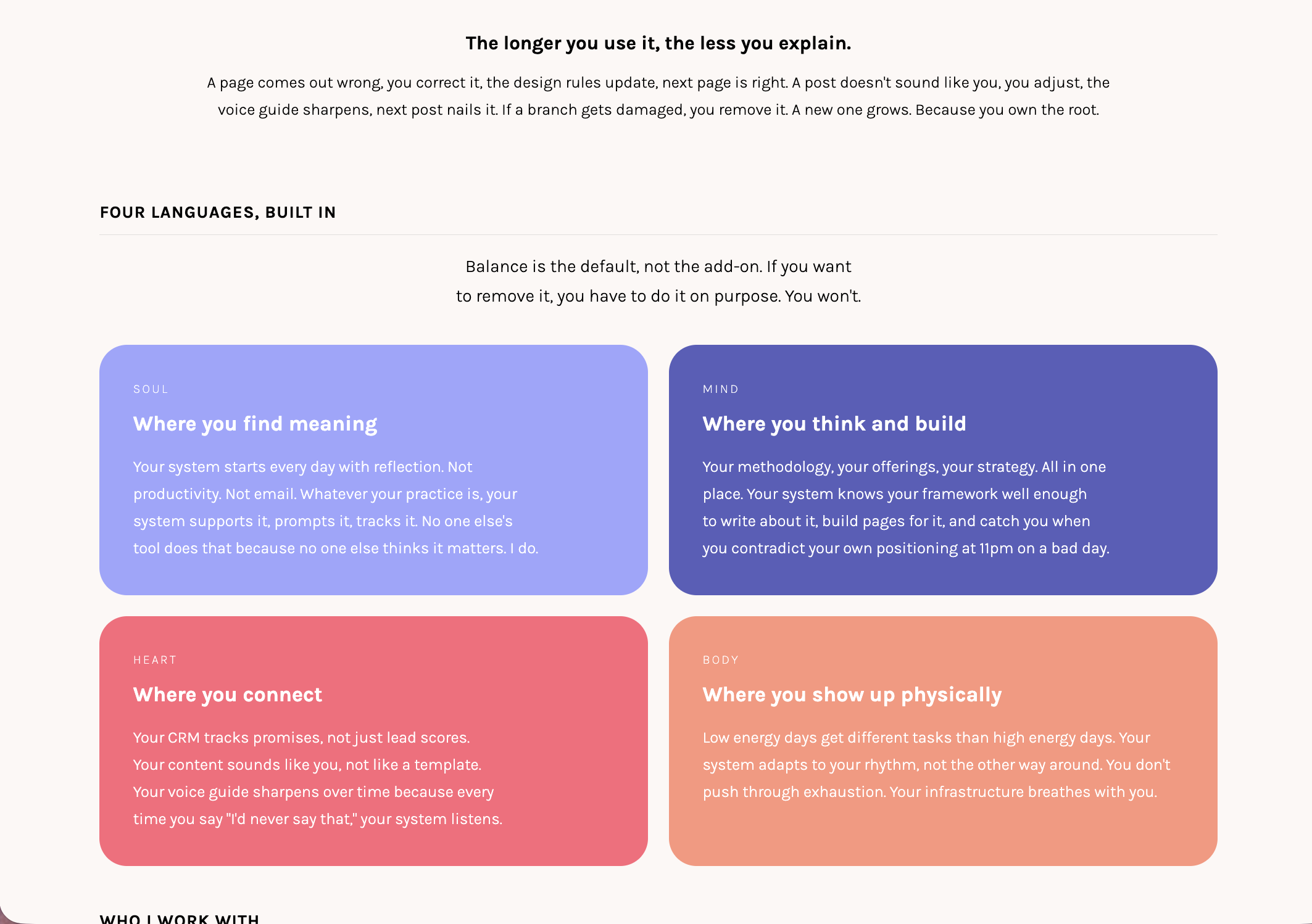
Your About tab
Your about page also lives inside your dashboard as the first tab. When you open your dashboard, the About tab shows a preview of your public story, pulled from the same file you just built.
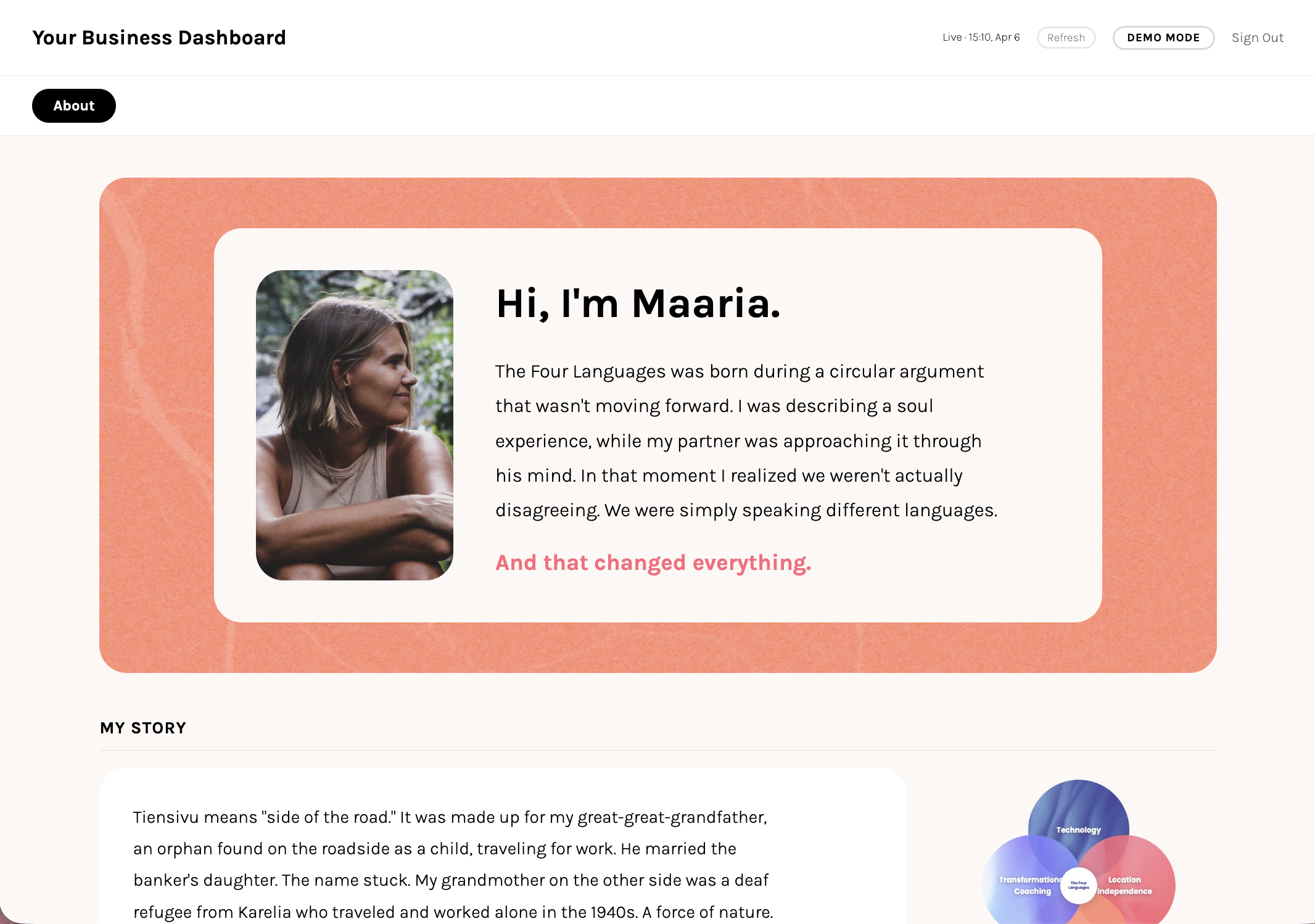
Your first dashboard tab
This is the About tab in your dashboard. By the end of this week, it shows your public story. The same words that live on your about page, visible right inside your system.